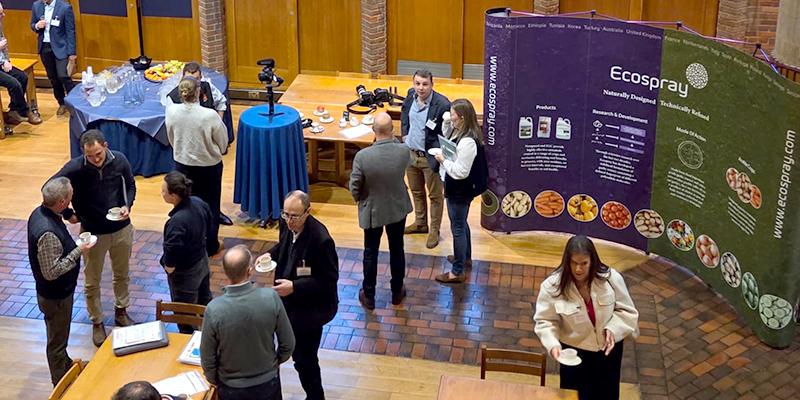
Ecospray joined growers, researchers, and industry leaders at the 36th Annual Cambridge Potato Conference, hosted by CUPGRA at the University of Cambridge. This event remains a vital forum for tackling the challenges in potato crop management, a crop that is central to global food security.
The Sustainability Imperative
The conversations at Cambridge reflected a clear priority: sustainability, soil health, and transparency for consumers are no longer optional, they are essential. For growers, this means balancing productivity with environmental responsibility. For us, it means developing solutions that reduce chemical dependency while maintaining yield and quality.

The Role of Biopesticides in Reducing Chemical Dependency
One of the most significant trends shaping crop protection is the move toward biopesticides, natural alternatives to conventional chemistry. Biopesticides, derived from naturally occurring substances such as plant extracts, offer a way to manage pests and diseases often without the long-term soil impact or residue concerns associated with synthetic pesticides.
Why does this matter? Regulatory pressure on conventional actives is increasing globally, and consumer demand for “cleaner” food is accelerating. At the same time, pests like potato cyst nematodes (PCN) remain a persistent threat to growers. Biopesticides provide a critical tool for integrated pest management, enabling growers to reduce reliance on synthetic nematicides while maintaining effective control.
The science behind biopesticides is advancing rapidly. Modern formulations are more stable, more targeted, and backed by rigorous efficacy data.
Collaboration Between Industry and Academia Accelerates Innovation
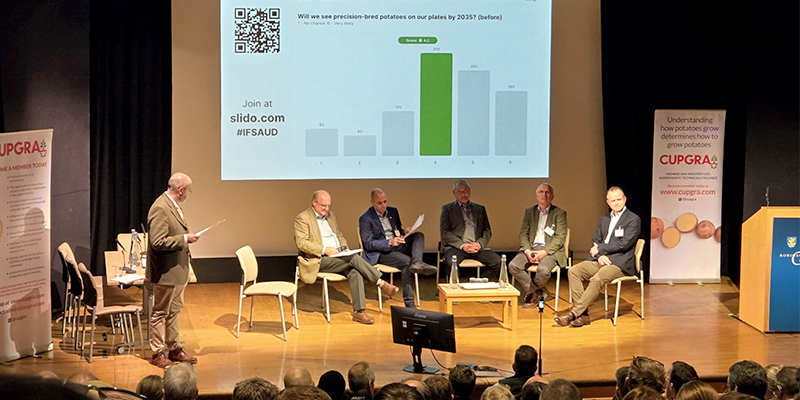
Innovation in crop science doesn’t happen in isolation. It requires collaboration across the entire ecosystem, manufacturers, growers and researchers. CUPGRA exemplifies this approach, bringing together stakeholders to share knowledge, align priorities, and accelerate progress.
Academic research plays a pivotal role in this process. At the conference, graduate students presented cutting-edge work on nematode biology, soil health, and disease prevention. These insights feed into development pipelines, ensuring that new solutions are grounded in robust science. Industry partnerships amplify this impact by providing resources, trial platforms, and market access. When academia and industry work together, innovation moves faster, from lab to field to market. This collaborative model is essential for addressing complex challenges.
Why This Matters for the Future
Potatoes are a cornerstone crop for global diets, but they face mounting pressures, from soil-borne pests to climate variability to consumer expectations. Meeting these challenges requires a shift in mindset: from short-term fixes to long-term resilience, from chemistry-heavy approaches to integrated strategies that combine conventional tools with natural alternatives.
Biopesticides are not a silver bullet, but they are a critical piece of the puzzle. Combined with precision agronomy, resistant varieties, and informed rotations, they enable growers to protect yields while safeguarding soil health for future generations.